
Why Finland Is the Happiest Country in the World (And What That Actually Means)
Finland has just been named the happiest country in the world. Again. For the ninth year running. At some point this stops being a news story and starts being a geological fact, like Finland also being flat or cold or disproportionately committed to heavy metal music.
The World Happiness Report lands every March and every March the same thing happens: Finnish newspapers report it with the mild satisfaction of someone whose train arrived on time, international media runs a variation of ‘What is Finland’s secret?’ and the rest of the world briefly considers whether it should eat more rye bread.
Having lived here for more than two decades, I can tell you that the secret is not rye bread. It is also not, as several lifestyle pieces have suggested, a mystical connection to nature or the particular quality of Finnish silence or the sauna. These things exist. They are not the answer.
What the ranking actually measures
The World Happiness Report is based on Gallup polling across 143 countries, asking people to evaluate their lives on a scale of zero to ten. The bottom rung of the ladder is the worst possible life; the top rung is the best. Finland has topped this ranking every year since 2018.
What drives the Finnish score is not euphoria. Finns are not, as a rule, euphoric. What drives it is the absence of certain things: corruption, uncertainty and the sense that the system is working against you. Finland ranks near the top globally for institutional trust, social support, freedom to make life choices and low corruption. The happiness is structural. It is what you get when the basics work.
The things that actually make it work
In Britain, the relationship between citizen and state resembles a long unhappy marriage where both parties have given up trying. You know the NHS is underfunded, that the trains will be late and that the housing system is a lottery you have already lost. You navigate around these things. You develop a certain grim resilience, which is admirable but not the same as happiness.
In Finland the assumption runs the other way. Schools are free and genuinely good. Healthcare works. The childcare system is heavily subsidised. When something goes wrong, whether a redundancy or an illness or a divorce, the safety net is real enough to catch you. This is not a utopia; Finnish politics are as messy as anywhere else and the economy has had difficult years. But the floor is higher here. The distance between a good life and a difficult one is shorter.
This is what Finns mean when they talk about tasa-arvo, equality, literally equal value. It is not an aspiration. It is a design principle. The school your child attends should not depend on your postcode. The doctor you see should not depend on your income. These are not radical ideas here. They are just how things work.

Why Finns do not seem particularly happy about it
The most disorienting thing about Finnish happiness, if you are coming from somewhere with a more demonstrative relationship to the concept, is that it does not look like happiness. Finns at a bus stop do not radiate contentment. Finnish social gatherings are not, on average, characterised by effusive expressions of joy.
What they are characterised by is something more durable: reliability. People say what they mean. Arrangements are kept. If a Finn tells you they will be somewhere at ten o’clock, they will be there at ten o’clock. This sounds small. Over twenty years it accumulates into something that feels, quietly and without announcement, like being able to trust the world.
Sisu, the Finnish concept of inner determination and getting through things without complaint, is part of this. It is not stoicism for its own sake. It is the recognition that life contains difficulty, that difficulty is not a personal failure and that getting on with things is more useful than performing distress about them. A country that has collectively internalised this tends to produce people who are satisfied with their lives, even when the weather is terrible, which in Finland it frequently is.
What the ranking does not tell you
Finland has one of the highest rates of depression in Europe. It also has one of the highest rates of alcohol consumption. The long winters are not a minor detail. Social isolation is a genuine and documented problem, particularly among men.
The happiness ranking captures something real and important. It does not capture everything. What it captures is the relationship between a citizen and their society: the sense that the system is fair, that institutions can be trusted and that if you work and pay taxes something will be there when you need it. On that measure, Finland is genuinely extraordinary.
Whether that is the same thing as being happy is a different question. The Finns would probably say it is a better question than most people ask.
Read Also
For more on Finnish culture and character, read our guide to Finnish sauna culture, find out why Finns love silence and the British cannot stop talking, or discover the Finnish guide to doing nothing properly. If Finnish food is more your thing, try lohikeitto, Finland’s national salmon soup, or the slow-cooked comfort of Karelian stew.
Joel Willans has spent more than twenty years in Finland trying to understand what makes this country tick. His book 101 Very Finnish Problems is the funniest and most affectionate guide to Finnish character available. If you are shopping for a Finn in your life, the Very Finnish Problems collection is built on exactly this kind of wry cultural observation.
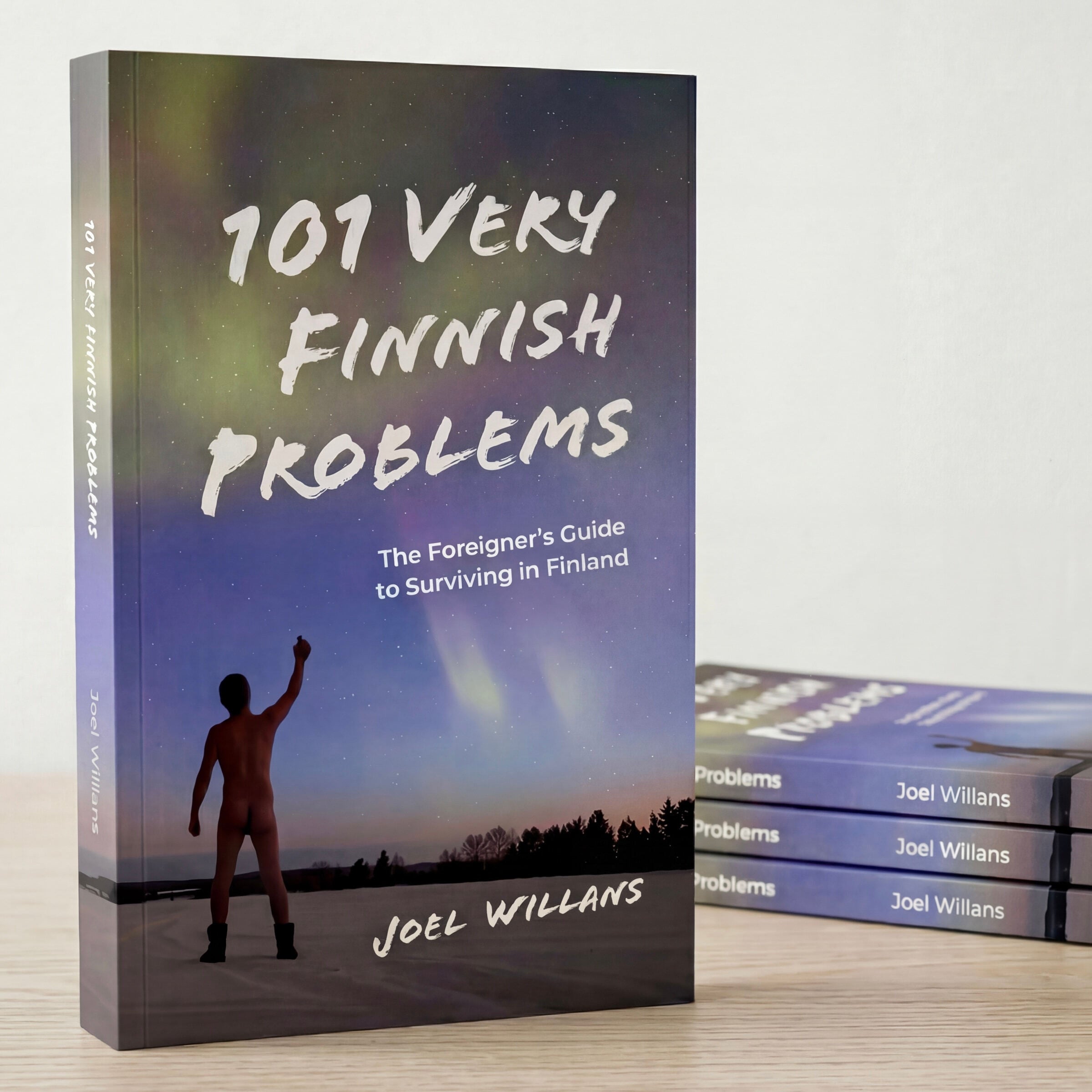
If Finnish happiness sounds like something worth understanding more deeply, the Sisu collection at Very Finnish Problems is a good place to start — or Joel’s book 101 Very Finnish Problems, which decodes Finnish life with the same wry affection. The Finland t-shirts make the same points in rather fewer words, which is arguably the more Finnish approach.


